

What it does
Mindful Harmony is a browser-based chord progression tool for songwriters and composers who want to see the theory behind each choice. It presents diatonic and chromatic options as playable chord cards, then shows how the progression relates to modes, keys, voice leading and the circle of fifths.
Build progressions with more than diatonic chords
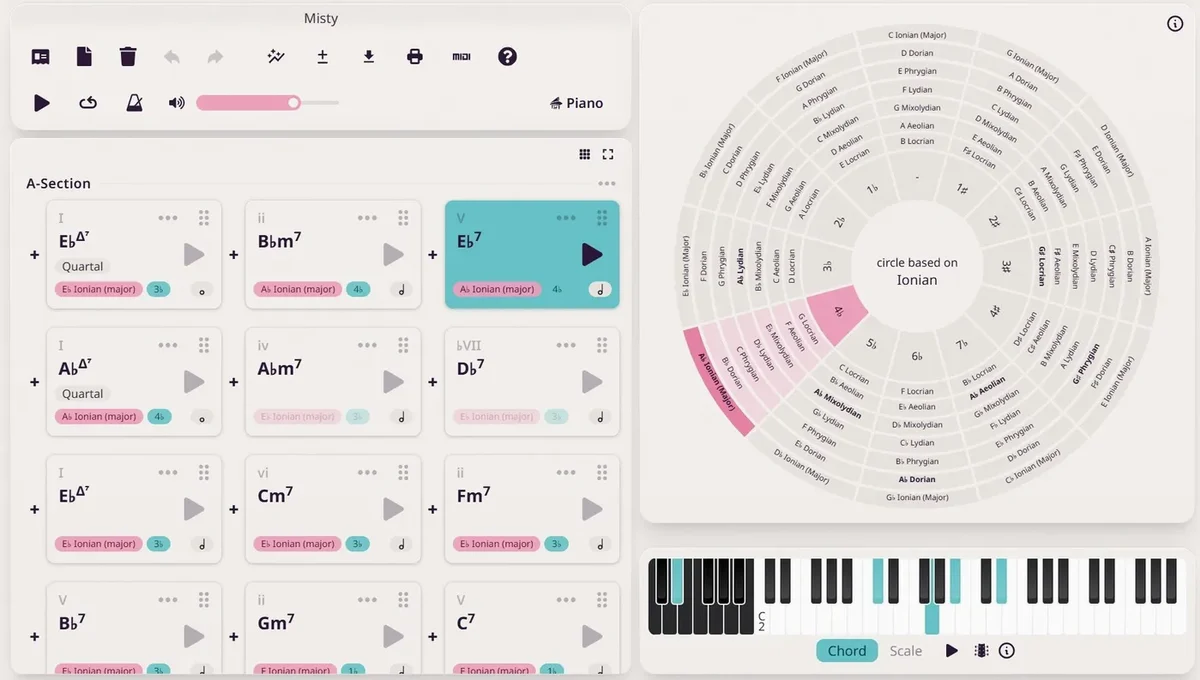
Start with a key and mode, then add chords from the main grid. Mindful Harmony can surface borrowed chords, secondary dominants, chromatic mediants, altered chords and other approaches without hiding the harmonic relationship. Each card shows the chord symbol, function and source scale, and the built-in piano lets you hear the result immediately.
The app is useful when a progression feels predictable but random chord generators are too arbitrary. It does not write the song for you. Instead, it puts plausible options within reach and explains where they come from.
Voicings, voice leading and modulation
Mindful Harmony includes a chord explorer with different voicings and a piano-roll view for connecting one chord to the next. You can customise the voice leading, edit notes manually and use divisi MIDI channels when a part needs to be split across instruments.
The circle of fifths updates with the progression and helps reveal relationships between keys. A modulation tool can search for pivot chords shared by two keys. More direct chromatic approaches, including augmented passing chords and tonicisation, are available when a smooth pivot is not the effect you want.
Projects can be organised into sections with comments, reordered by dragging and printed in a cleaner layout. The app also includes a metronome and chord search. Community pages let users publish progressions, browse other people's work and save ideas to a library.
MIDI and DAW workflow
Mindful Harmony is a web app, not a VST or Audio Unit plugin. You can connect MIDI input and output, record the app's output into a DAW, or export a progression as a MIDI file and drag it into a project. MIDI export is a premium feature.
That separation suits writers who want to settle the harmony before choosing sounds. Producers who prefer to audition chords inside an instrument track may find a DAW plugin more immediate.
Purchase and account details
The current public page promotes paid lifetime access and a 30-day money-back guarantee. Mindful Harmony's terms also allow monthly plans, so check the checkout for the options available in your region. A lifetime purchase provides access while the hosted service continues to operate; it is not a perpetual offline software licence.
An account requires a name and email address. Projects are stored on Mindful Harmony's servers so they can sync between devices. Songs remain private unless you choose to share them with the community. The service is operated in Sweden and its privacy policy describes GDPR rights, analytics and the third parties used for hosting and payments.
Practical limitations
Mindful Harmony is piano-first. It includes a guitar fretboard, but the developer notes that guitar shapes are translated from the piano voicing and may not always be practical to play. There is no native desktop plugin, and the working project depends on the browser service and your account.
The interface goes well beyond basic triads. That is the point, but beginners may need time to understand the chord labels, modal names and voice-leading controls. The app explains the relationships as you work; it does not replace a structured theory course.
Alternatives to Mindful Harmony
- Hooktheory combines a chord-and-melody sketchpad with song analysis and interactive theory books. It is a better fit when melody writing and learning from existing songs matter as much as harmonic exploration.
- Scaler 3 runs as a desktop app and DAW plugin, with chord detection, arrangement lanes, MIDI editing and hosted instruments. It suits producers who want harmony tools inside a production workflow.