A TikTok clip can introduce someone to your music. The useful question is what they do next: find the full song, follow you, use the sound or come back for another video.
Start with one release and a few ways to present it. Play the strongest section, explain the line behind it, or show how the arrangement changed. Check that listeners can find the right track, then use TikTok’s own analytics to see which posts earn more than a passing view.
You can do this with a phone, clear audio and a manageable posting routine. Here’s how to build a TikTok music promotion plan around the songs you already make.
Some links in this guide are affiliate links. If you subscribe through them, MusicianStack may earn a commission.
How to promote your music on TikTok
Before filming a batch of videos, put these pieces in place:
- Choose a song and the passage you want people to remember.
- If it is a released track, check that your distributor has delivered it to TikTok and that the correct sound is available.
- Make your artist name and the song title easy to find on your profile and in relevant posts.
- Choose three content ideas you can make without turning every rehearsal into a production shoot.
- Decide what you want to learn from the posts, then compare their performance after the same amount of time.
Building a recognizable identity helps. A singer sharing stripped-back versions of original songs gives a new listener a clearer reason to follow than an account that jumps between unrelated trends. You can experiment while keeping the music at the centre.
Get your music into TikTok’s sound library
You can post a video containing your own original audio. Delivering a released song to TikTok’s catalog is a separate step: it makes the track available as a sound people can select for their posts.
Many distributors offer TikTok delivery. For example, DistroKid’s current instructions say to select “TikTok & other Bytedance stores” when uploading, or use “Add to more stores” for an existing release. DistroKid is a paid service. Its separate Social Media Pack is not required for audio-library delivery or library monetization.
Check your distributor’s terms, territories and release status. Don’t assume that uploading a track makes it immediately available everywhere.
Check the sound listeners will use
Search TikTok for your artist name and song title, then check the sound results available in your version of the app. Open the matching sound and listen to it. Confirm the title, artist credit and recording, rather than choosing the first result with a similar name.
Keep a link to the correct sound. When you ask a collaborator to use your track, send that link and explain which passage you have in mind. It saves them searching through similarly named sounds or different recordings.
If the release is missing or credited incorrectly, check the delivery status with your distributor. A video uploaded with original audio is not evidence that the official catalog delivery has completed.
Set up the artist tools available to you
An Artist Account and TikTok for Artists do different jobs. Artist Account features help identify the artist and present their music. TikTok for Artists provides music and audience insights for eligible certified Artist Accounts.
Start at the official artist portal to check access in your region. Account labels, eligibility and features can change, so follow the requirements shown for your account rather than an old account-switching tutorial.
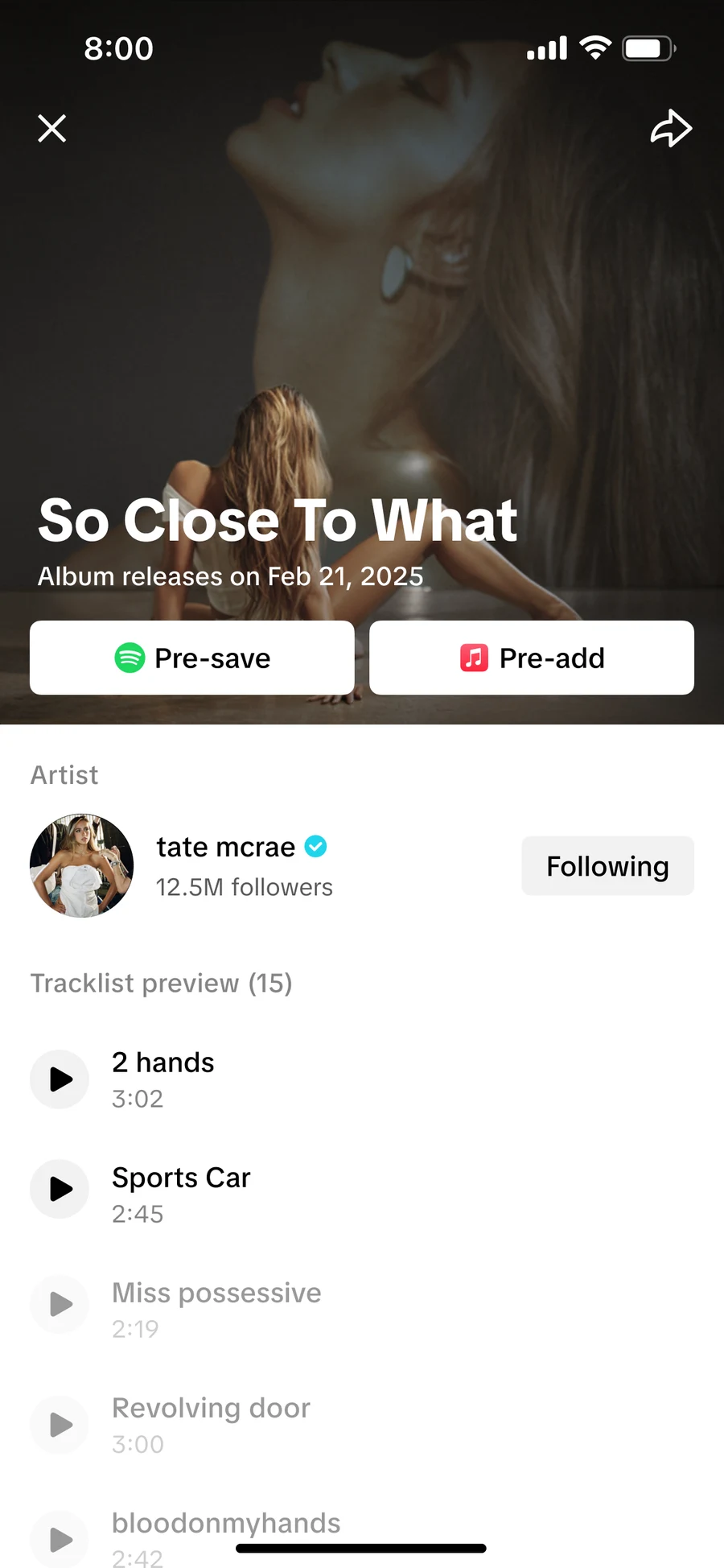
TikTok’s 2025 platform announcement also introduced a pre-release tool for album pre-saves on Spotify and Apple Music. Check the release types and services supported by the tools currently offered to you. A pre-save campaign still needs a clear reason for a listener to care about the release.
Make the profile useful
Use the artist name people will search for. Explain what you make in a short bio, and make the current release easy to identify. If your account has a website-link feature, send listeners to a useful release page rather than a homepage that makes them search again.
You don’t need to switch to a business account just to obtain native analytics. TikTok Studio has creator tools, while business accounts have different music-library access. Check the current account guidance before changing account type.
For more help making a short artist introduction, see our musician bio guide. The examples focus on Instagram, but the exercise of explaining your music clearly is useful here too.
TikTok content ideas for musicians
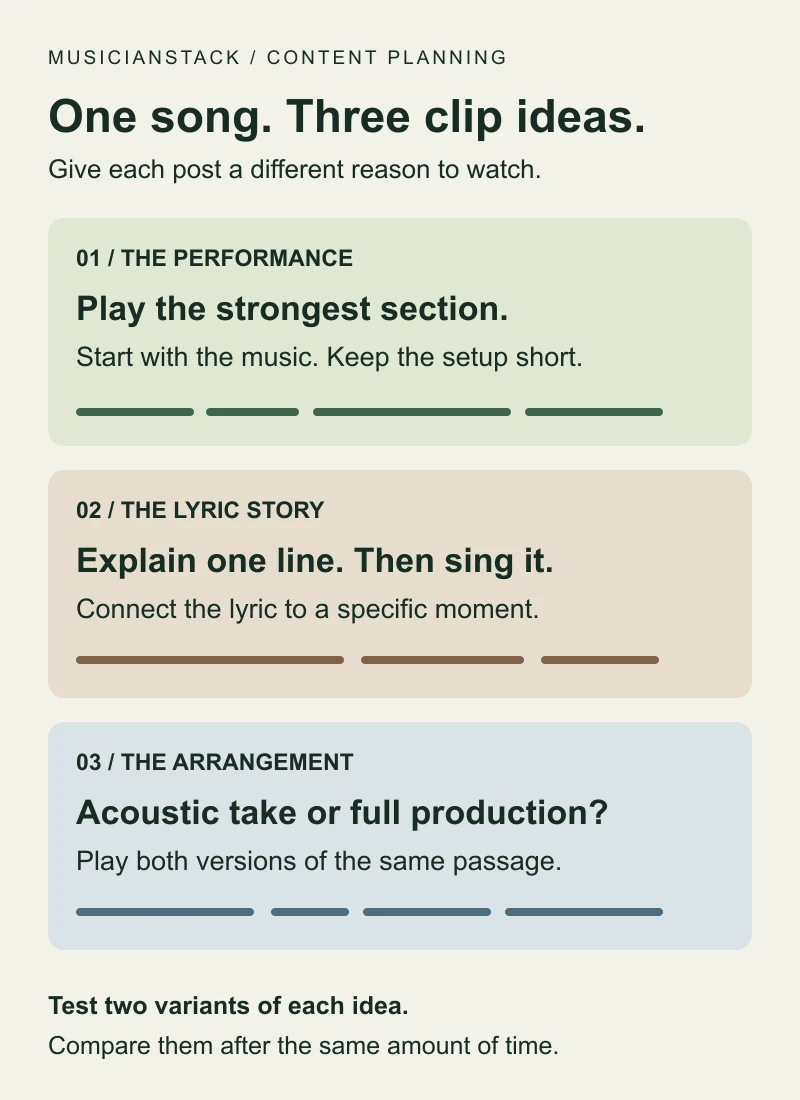
A release announcement tells people a song exists. Other posts can give them a reason to listen to it. Build several ideas around the same song before moving on to the next one.
| Format | What to film | What makes it useful |
|---|---|---|
| Direct performance | Start on the chorus, riff or strongest vocal passage | A new listener hears the music immediately |
| Lyric story | Explain the moment behind one line, then sing it | The listener gets a specific reason to care |
| Arrangement comparison | Play the same section acoustic and with the full production | The difference gives people something concrete to discuss |
| Demo to release | Compare an early recording with the finished passage | The creative change is audible |
| Open musical part | Leave space for a harmony, solo or verse, using collaboration features where available | Another musician has a clear way to contribute |
| Answer a question | Demonstrate a chord, technique or sound someone asked about | A real audience question becomes a useful follow-up |
Write an opening that fits the clip
Give the viewer a reason to stay, then deliver on it. “The chorus before and after we changed the bass line” sets up an audible comparison. “I wrote this line after missing the last train home” gives a lyric story a specific starting point. A strong performance may need no spoken introduction.
Avoid spending the opening apologizing, adjusting equipment or asking people to wait for the good part. Cut to the part you wanted them to hear.
Use readable on-screen text where it helps someone follow the idea, and captions for speech. Keep the instrument, face or demonstration visible around the app’s controls. Clear sound matters more than an elaborate set. Our apps for musicians guide includes tools for recording and preparing musical ideas.
Choose length around the idea
There is no useful universal rule that every music video should last 12 or 13 seconds. A riff demonstration and the story behind a song need different amounts of time.
TikTok’s camera-tools help currently lists recordings up to 10 minutes and uploads up to 60 minutes. Selecting a sound can limit the video to that sound’s length. Those are technical limits, not targets to aim for.
Try a concise performance clip and a longer explanation when the material warrants it. Remove dead time from both. Compare results with similar formats and lengths before deciding that short or long videos work better for your audience.
A two-week plan for one release
Here is a manageable experiment: choose three of the formats above and make two versions of each over two weeks. Six posts is a starting point you can adapt to your workload, not a TikTok requirement.
For example:
- In the first week, post a direct performance, the story behind a lyric and an acoustic/full-production comparison.
- In the second week, try a different opening or passage for each format. Answer a useful comment if one gives you a stronger idea.
Keep a simple record of the song passage, format, opening, length and publication date. Check each post after the same elapsed time, such as two days, and review again later if it continues to attract activity. Changing the opening, song section and recording style all at once makes it harder to tell what helped.
Give each post one sensible next step. A listener might want the song title, the full recording or another version. Make that easy to find without turning every clip into a sales pitch.
Use TikTok search and trends selectively
Search for the genre, instrument, technique or situation that fits the video. Describe it plainly in the post. Relevant hashtags can help identify the subject, but a pile of unrelated trending tags gives a listener little information about your music.
TikTok’s Creator Search Insights shows searched topics and areas with gaps in content. To find it, search “Creator Search Insights” in the app and open the tool. Availability can vary. Its “Searches by followers” filter requires more than 1,000 followers, which is a restriction on that filter rather than the whole tool.
Use the results to find an idea you can answer well. A bassist might demonstrate a technique people search for, then show it in an original song. That is a more natural connection than attaching the song to a trend with no musical or audience fit.
A trend may be popular, but if it has nothing to do with the theme you’ve chosen, leave it alone. You have songs to finish as well.
What the recommendation system tells you
TikTok describes recommendation signals including user interactions, content information and user information. Watching, skipping and time spent watching are among the signals. Their importance varies, and search also considers how well content matches the query.
That gives you practical things to work on: a relevant subject, an opening worth staying for and a video that delivers what it promises. It does not give you a guaranteed recipe for distribution. A large follower count or a particular hashtag cannot substitute for checking how people respond to the actual post.
TikTok analytics tools for musicians
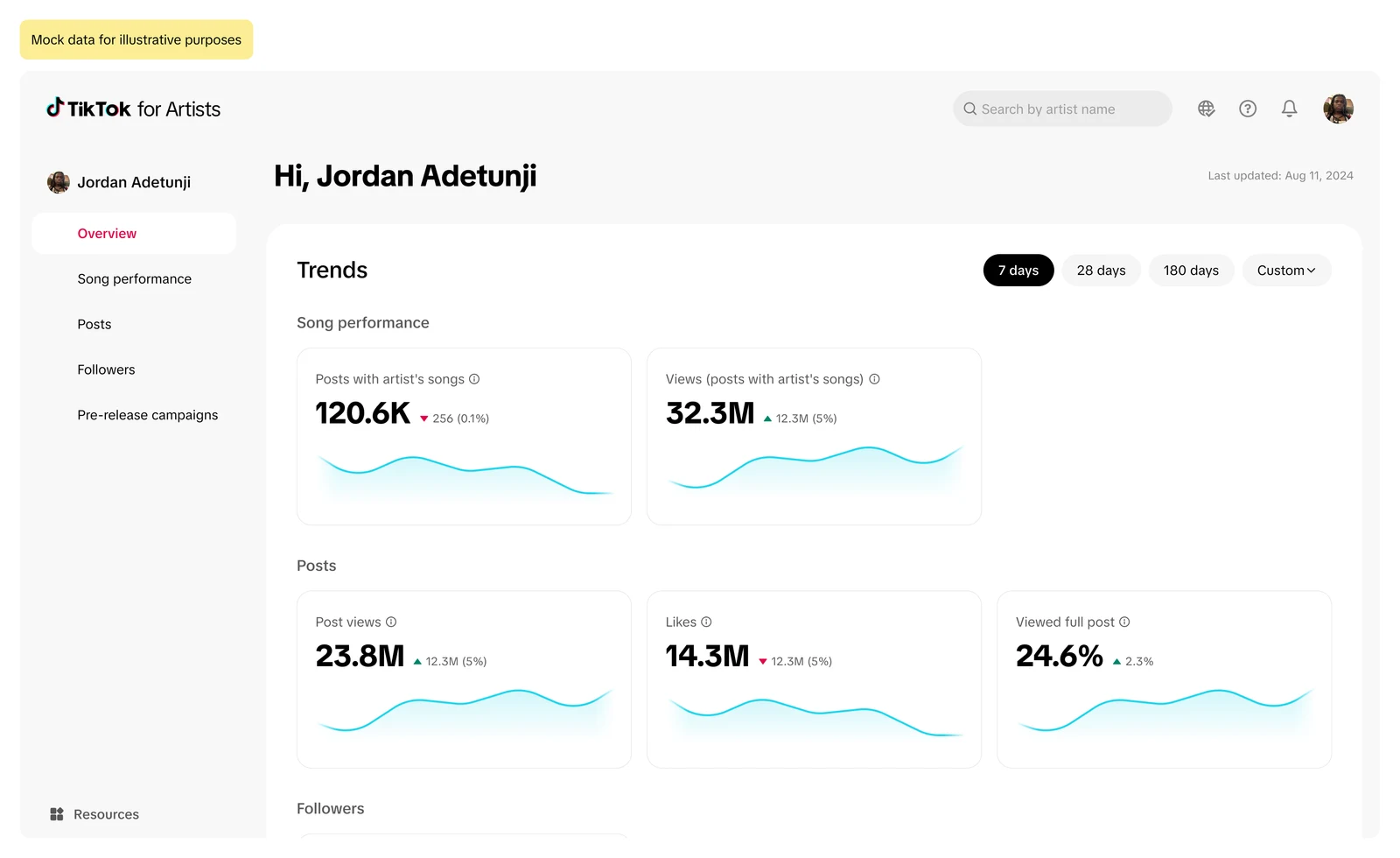
Start with TikTok Studio
TikTok Studio provides native account and post analytics. In the app, go to Profile, open the menu and select TikTok Studio. The available tools can vary by account and region, and account analytics require at least one public post.
Look beyond views. Depending on the report available, check watch behavior, shares, comments and follower changes. Read the comments too. “What’s this song called?” tells you something different from a discussion that has nothing to do with the music.
Use TikTok for Artists for music activity
If you have access, TikTok for Artists adds a view of activity around your songs, alongside post and follower insights. Use it to ask whether people are making posts with a track and which songs are attracting attention.
Keep the measurements separate
| Question | What to check |
|---|---|
| Did the clip hold attention? | Available watch-time and completion metrics, compared with similar posts |
| Did it prompt interest? | Shares, relevant comments, profile activity and follows where reported |
| Did people use the song? | Sound activity and artist reports, where available |
| Did listeners leave TikTok? | Click data from your release page or tracked link, if available |
| Did listening grow elsewhere? | Your streaming-service artist reports, checked separately |
A rise in streams during a TikTok campaign is worth investigating. It does not prove which post caused it. Playlist placements, gigs and other promotion may be happening at the same time.
Third-party tools become useful when you need research beyond your own account, such as comparing creators or tracking conversations. Exolyt focuses on TikTok analytics and social intelligence. HypeAuditor covers influencer research and campaign work. Check their current scope and plans against a specific job before adding a subscription. Native reports are a sensible place to start.
Royalties, covers and paid promotion
Music royalties and creator income are different
Music-usage royalties depend on the rights involved and the arrangement with your distributor or other representatives. Creator monetization programs and brand partnerships are separate sources of income.
DistroKid’s TikTok monetization guidance distinguishes a song selected from the audio library from music already embedded in an uploaded video. It describes separate collection options for those uses. Check your own distributor’s terms rather than assuming every use earns the same amount.
An influencer earnings calculator cannot tell you what your song will earn in royalties. Use statements from the service collecting your music income to understand what has actually been reported.
Check the music rights for the intended use
Use music you own or have permission to use. Recording a cover yourself does not remove the rights in the underlying song. Check TikTok’s copyright guidance, the permissions you hold and the rules for the particular use.
Music available for an ordinary post is not automatically cleared for an advertisement or branded post. TikTok’s commercial music guidance recommends its Commercial Music Library for commercial content, or obtaining the necessary rights for music outside it. Owning your recording also does not necessarily mean you control every sample or composition in it.
Choose collaborators around the song
If you pay creators to use a track, look for a relevant audience and a format that suits the music. Recent posts, audience response and the creator’s musical interests are more useful selection criteria than celebrity status alone.
Agree on the sound link, the idea, what will be delivered and how you will assess the result. Paid promotion and other commercial posts must also follow TikTok’s content-disclosure requirements.
When a post or sound isn’t working
If a catalog sound is missing, start with your distributor’s delivery status and the artist/title metadata. Check the account and territory involved before repeatedly uploading duplicates.
If audio is muted, inspect the notice in TikTok and the rights or availability issue it identifies. Use the platform’s review or appeal process when appropriate. Reposting the same file does not resolve a rights problem.
If a post gets views but little interest in the music, try a version where the song arrives earlier and the title is easier to find. If people ask the same question, make the answer visible in the next post. Work on the specific point where viewers lose interest rather than changing everything after one disappointing result.
Frequently asked questions
Can I post my own song without a distributor?
You can post a video containing original audio you have the rights to use. Getting a released track into TikTok’s selectable music catalog is a separate distribution task. Check that delivery if you want fans to find the official sound.
Do musicians need a business account for analytics?
Native creator analytics are available through TikTok Studio. Check the current account options and music-library restrictions before switching account type. Artist Account features and TikTok for Artists have their own access requirements.
Is TikTok better than Instagram for musicians?
It depends on where your listeners are and what you can make consistently. Test useful content on each platform and compare audience response and listening interest. For planning across channels, see our music marketing guide.
How often should musicians post on TikTok?
Choose a pace that leaves time to make music and respond to listeners. The six-post experiment above gives you a few comparable ideas to evaluate. It is not a minimum frequency or a promise of growth.
Do short videos always perform better?
No single length suits every idea. A performance excerpt may be brief, while a technique demonstration or song story needs more time. Compare similar posts, remove dead time and use the analytics available to your account.
About the author
Keith, a musician for over 30 years, is still in love with music as much as ever and remains a passionate consumer of music by experimenting with new styles, genres and sounds.